Friday, 14 September 2012

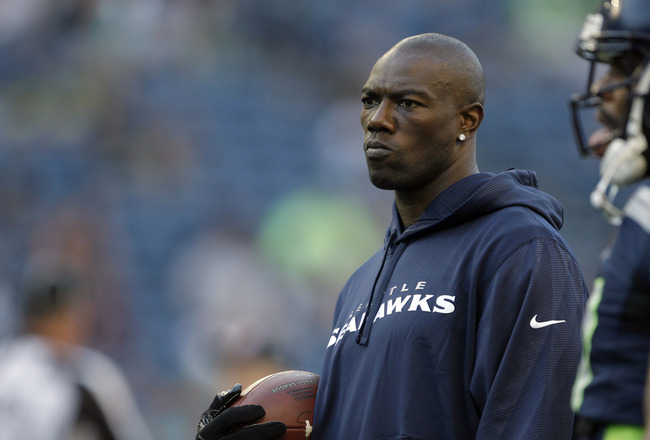
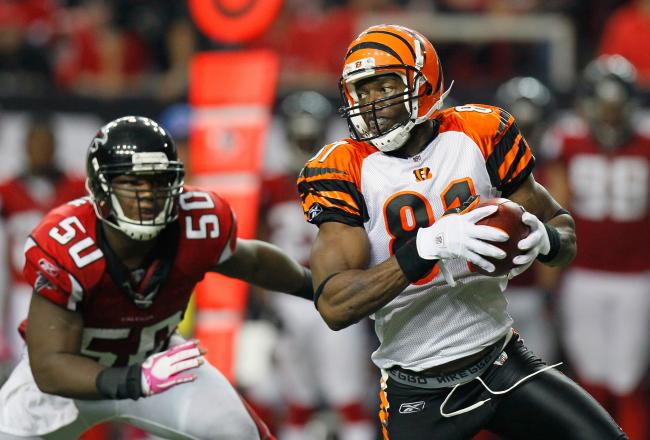
The Morning Orange: Rob Moore, the Syracuse aide, says diva receivers are exception, not the rule.


His primary job is to school those athletes in his charge in the finer arts of route-running and pass-catching and, thus, chains-moving and touchdown-scoring. But Rob Moore, Syracuse University’s wide receivers coach, understands that his duties also include providing more than just football guidance.

Indeed, his task at SU is to make certain that his guys understand that good hands don’t necessarily make for good teammates . . . for good citizens . . . for good people.
Always a tough gig, mentoring becomes even more difficult when the mentees -- in Moore’s case, the Orange wideouts -- can look to the NFL and see . . . well, clowns.
Dez Bryant . . . Randy Moss . . . Chad Johnson . . . Terrell Owens. You get the drift.

“You know, when I came up in the league, the veterans really straightened the young players out,” said Moore, who played 10 seasons (1990-’99) for the New York Jets and Arizona Cardinals. “I was lucky. I had a great mentor in Freeman McNeil. He took me under his wing and taught me how to be a pro. The veterans took care of the young guys. I don’t think you have much of that today.

“The old veterans used to take pride in that. Now, with the way the collective bargaining agreement is set up, the NFL is a young man’s league. And I don’t think those guys are ready to help some of the (even) younger guys out. So, they let them shoot themselves in the foot, which means they’ll get to play a little bit longer.”
There may not be a direct connection to the misbehavior of certain NFL scalawags and impressionable college players, but it takes no great leap to imagine that the Bryants and Mosses and Johnsons and Owenses -- each somewhere between diva and cad -- do have their influence. And Moore thinks they’ve been aided and abetted by technology.
“The social media is really to blame for a lot of that,” he said. “You can act crazy and millions of people see it, and you become a celebrity. You get a TV show and all of those things. I think social media promotes that kind of behavior. There still are certain guys who carry themselves like pros and really do a great job of carrying the torch in the NFL and what the league really represents. But I think when you have the social media and you have guys who enjoy it a little too much, that’s what you get.”

Moore is in his third year on Doug Marrone’s staff and remains pretty much what he was as a star Syracuse receiver in 1987, ’88 and ’89 (during which he caught 106 passes for 2,122 yards and scored 22 touchdowns) and as a Pro Bowler with both the Jets (’94) and the Cardinals (’97). That is, a man with a certain dignity.
Oh, and with clear expectations, embedded in him by his parents, on how one should conduct one’s self.

“I do think the majority of these guys today get it,” said Moore, who'll be 44 at the end of the month. “But there are some who don’t. If I behaved like them, my mom would have shot me and my dad would probably have put his size-12 where nobody could see it. At the end of the day, at least when I played, I was always conscious about how my family would be represented. I think sometimes guys lose sight of that.”
His challenge is to see that the Orange wideouts don't.

Monday, 10 September 2012

Accusations show players like Terrell Owens need more financial advocates in their corner.


As deals go, it’s neither new nor complex.
A sports agent lands a client and then recommends a financial adviser. Or vice versa. The relationship between the agent/adviser extends through the years, through the rosters. Maybe they recruit together. Maybe they just vouch for “their guy.” Maybe there are kickbacks. Maybe there is the expectation of future swaps.
However it goes down in the end a player, often poorly prepared by a college sports system focused on eligibility and not education, often from a family background short on savings accounts let alone mortgages and stock portfolios, thinks he has two sets of independent, trustworthy eyes on his money. Instead he has one.
Even if nobody aims to rip him off, to risk his money, the fiduciary responsibility is corrupted, the honesty lost, the motives open to question.
Whether this is what was pulled on Terrell Owens by his former agent, Drew Rosenhaus, and the financial adviser he recommended T.O. sign with, Jeff Rubin, is a matter for investigators and civil courts.
Yahoo! Sports reported Tuesday that the NFLPA is looking into the Rosenhaus-Rubin relationship after widespread player losses. Rosenhaus denied wrongdoing. Rubin declined comment.
Owens just knows he’s 38, perhaps headed toward bankruptcy and one of the reasons his approximately $80 million in NFL earnings has all but vanished is because bad deals and poor oversight from an agent-financial adviser team.
[Exclusive: Drew Rosenhaus scrutinized for relationship with financial adviser]
Or put it this way: how could Owens, late in his career, wind up throwing a couple of his last million dollars at a risky, rural Alabama bingo parlor project?
Then again, how could 34 other athletes, 18 of them Rosenhaus’ clients, get roped in for what bankruptcy filings indicate could be a combined $43.6 million?
“As a player without much understanding of the financial realm, we’re easy prey,” Owens told Yahoo! Sports. “How do you decipher who’s good and who’s bad? For someone to work as hard for their money as we do, to have it taken away by people we trust, who we find out later had other motives, it’s a sick feeling.”
As sympathetic victims go, T.O. isn’t much. He has four kids (and four monthly paternity payments) from four women, houses all over the place and a well-earned reputation as a high-maintenance star.
It’d be a bigger surprise if T.O. turned out to be a fiscally conservative saver, financially set for life rather than a guy nearly busted out less than two years from his last NFL reception. That much he gets.
“Some of this is my fault,” Owens says, “because I had ultimate responsibility for my finances.”
[Also: Donovan McNabb accepts reality, moves toward a broadcasting career]
Many fans will laugh at Owens’ situation. Or they’ll shake their head in disgust. Or perhaps use his failure to prop up their own self worth – they may never have been able to blow past a cornerback like T.O., but if they could they sure wouldn’t have blown through money like him.
That’s the fans’ right. They owe Owens nothing.
It’s so many others that owe if not him, then the next him. At least he’s standing up and explaining his own embarrassment, even speaking both formally and privately to young players about his experience.
And again, this isn’t a new deal, or one where suspicions center solely on Rosenhaus and Rubin. This is how the game is played, an industry with the same old agents and the same old financial advisers but an endless crop of brand new millionaires. It’s a world where access to the young, rich and naïve is coveted whether you’re a real estate agent or a jeweler or a luxury car dealer.
(Hint for a player: if your agent drives an outrageously expensive sports car, and recommends you buy from the same dealer, his “guy,” consider the possibility the agent is getting a deal on his ride in exchange for bringing in your full-price self. Really, just consider the possibility of it.)
“We recommend you use Jeff,” Owens said Rosenhaus had told him. “ 'He handles our clients. We trust him.’ I never knew who Jeff Rubin was before Drew introduced me to him. Drew was supposed to be the best agent.”
At one point, as Yahoo! Sports’ Jason Cole and Rand Getlin reported, Rosenhaus and Rubin shared at least 26 clients.
A 2009 Sports Illustrated study found that two years after retirement, “78 percent of former NFL players have gone bankrupt or are under financial stress because of joblessness or divorce.” It was just the latest in a long line of similar findings through the decades.
The NCAA focuses on “agents,” so they get the boldest of headlines and blackest of eyes. In truth, it’s just a catchall phrase. The traditional sports agent isn’t the only one recruiting unpaid college stars, it’s the financial guys too, or the workout gurus, or an old coach, or a guy from around the way back home.
And whomever wins the trust, whomever gets the first signature, can dictate what is often an overwhelmed young man’s next three or four hires. And you’d be a trusting soul to believe something that valuable comes for free.
Yahoo! Sports Radio: Jason Cole on Drew Rosenhaus not receiving money from bingo venture]
This is the challenge for the union, who fights for the players to make the money and ought to fight just as hard for them to keep it. This is the challenge for the NFL, always image conscious, for whom there can be no positive to generations of ex-players that are broke.
The Rosenhaus-Rubin relation is being investigated by the NFLPA and it needs to be a thorough and serious one. So too does the approach to educating players about the system. Not just when they show up in the league, but when they’re promising high school and college prospects who need to hear some kind of message of caution before they sign.
Every player needs not just an agent and a financial adviser but an attorney, a third party who makes teaming up less likely (although not impossible). They need a union that investigates conflicts of interest more rigorously.
They also need the NFLPA to work to bring in more reputable faces, proven financial advisers from major firms who manage money well but aren’t interested or comfortable in the current shark-infested cesspool of client recruitment. They need to create an environment where players can meet advisers outside of some champagne room.
Look, these cases are complicated. The reporting delves into bankruptcy courts and depositions and agent-on-agent crime, lots of shouting and finger-pointing. Owens, again, isn’t an easy poster child for sympathy. There is only so much attention a deal like this is going to get, here at the start of the season.
And, of course a scandal involving the media-connected Rosenhaus is going to be ignored by some outlets that rely on him for scoops. That’s also part of the game.
It’s the union and the league that needs to simplify things, slow it down and explain it to young players who aren’t well versed in finances.
It’s that tandem that has to care about what the fans won’t, because it just goes on and on and on, a silent drain on too many athletes.
It’s the NFLPA and the NFL together that need to police the problem and then pound on the heads of the current and future Terrell Owens’ until at least some of naïveté is worn away, until some of that easy prey becomes a bit more difficult to snag.


Tuesday, 21 August 2012

Struggling Terrell Owens Drops the Ball in Seattle Debut.


The Terrell Owens era in Seattle got off to a dubious start this weekend as the veteran wide receiver struggled in his first NFL action in nearly two years.
Owens, who is trying to prove that he is fully recovered from a knee injury that sidelined him for all of the 2011 season, failed to catch any of the five passes thrown his way in a 30-10 win at Denver on Saturday evening. His most egregious mistake was a drop of a perfectly thrown 46-yard ball by quarterback Matt Flynn just at the goal line that would have resulted in a touchdown. Two previous attempts to get him the ball fell short due to poor throws from Flynn, while two others were broken up by the Broncos defense.
Now playing his 16th NFL season, Owens, 38, had raced by Broncos cornerback Chris Harris on a deep post and appeared poised for the easy score, only to see the ball slip out of his fingers.
The contest marked his first game action since playing with the Cincinnati Bengals in Week 15 of the 2010 season.
Seattle coach Pete Carroll said following the game that he remained confident in Owens’ ability to stretch defenses and help his team win.
Owens ranks as among the most productive receivers in league history with his 1,078 receptions for 15,934 yards and 153 touchdowns, but has repeatedly worn out his welcome in previous stops in San Francisco, Philadelphia, Dallas, Buffalo and Cincinnati with his boorish antics.
So far, so good in the Pacific Northwest as Owens and continues to say and do the right things while off the field.
All that’s left now is his performance on the field.
Seattle resumes preseason play this Friday evening when it travels to Kansas City. The Seahawks will open the regular season at Arizona on Sept. 9.

Sunday, 19 August 2012

Terrell Owens: Why T.O. Will Be a Factor for the Seattle Seahawks.


Thirty-eight-year old Terrell Owens will make an attempt to revive his career once again, and this time he actually has a good chance at doing so.
The 16-year veteran has been out of the league for two years, but it seems as though he is still in tip-top shape and can compete at the NFL level. The last time we saw him in an NFL jersey was in 2010 with the Cincinnati Bengals.
He was able to make nine touchdown catches even with Chad Ochocinco on the other side of the field. That means the potential is there. Here are four reasons why T.O. will be a factor for the Seahawks.

Friday, 17 August 2012

Terrell Owens to play for Seattle against Denver.


 Peyton Manning's debut in Denver won't hog all the attention. Terrell Owens will be taking some himself.
Owens will make his return to the NFL when the Seattle Seahawks play the Broncos on Saturday night. Seattle coach Pete Carroll didn't give specifics on how many snaps Owens will get in the second preseason game for the Seahawks, but he did say it would be early in the game.
''I'm not going to tell you how many plays it will be,'' Carroll said. ''We'll see how it goes.''
Owens joined the Seahawks (No. 22 in the AP Pro32) on Aug. 6 and had just a couple of days of practice before the preseason opener against Tennessee. Carroll said he didn't think it was fair to run Owens out there that quickly, but feels he's ready after two weeks of work.
Owens arrived in camp in excellent shape and has looked impressive at times during practice. But if he's to make the Seahawks' final roster, Owens will need to show in a game that he's fully recovered from a knee injury that kept him out of the NFL for the entire 2011 season.
Saturday against the Broncos will be his first NFL game action since Week 15 of the 2010 season with Cincinnati. Owens went without a catch in that final game against Cleveland.
''He's ready to go,'' Carroll said. ''He had two good weeks of work, and he came in in great shape so he's ready to go.''
The game against Denver will also be the first chance for Carroll to get a look at most of his receivers and try to figure out what has become a jumbled position. The arrival of Owens and Braylon Edwardsadded to a corps that included Sidney Rice, Doug Baldwin, Golden Tate, Ben Obomanu, Deon Butler and Ricardo Lockette.
Carroll and the Seahawks coaching staff must decide how many of those receivers to keep and whether holding on to veterans Owens and Edwards would trump giving shots to younger players like Butler, Lockette and others.
Additionally, there is the concern about Rice's health. Rice is coming off surgeries on both shoulders over the winter. He was cleared earlier this week for full practice after being stuck in a red no-contact jersey for the first two weeks, but won't play against the Broncos.
Owens has been working at the flanker position in the Seahawks offense behind Rice. Edwards has been mostly with the No. 2 offense at split end behind Tate.
''I like our group a lot, and we've become even more competitive and more experienced with the guys that will come in to add to it,'' Carroll said. ''We're just going to wait. We don't have to do anything right now. We just keep giving these guys turns in practice and get familiar and comfortable with them and also see them in the games, and add it all up together at the end. It's a really good position group for us right now.''
Notes: Seattle signed OL Kris O'Dowd on Thursday to add depth on the offensive line after Lemuel Jeanpierre was slowed by a groin injury and John Moffitt had surgery on his elbow. Seattle released K Carson Wiggs to clear a roster spot. ... Carroll would not say if RB Marshawn Lynch will play against the Broncos. Rookie RB Robert Turbin got most of the carries against Tennessee.

Sunday, 8 July 2012

Oakland Raiders: Why Terrell Owens Would Be a Good Fit in Oakland.


The man famous for his exotic end-zone celebrations and off-the-field antics is still on the free-agent market.
The Oakland Raiders would be wise to sign him for a multitude of reasons, regardless of the fact that he can be a headache. Just look at the team across the Bay—the San Francisco 49ers signed an aging Randy Moss for the right reasons and the Raiders would be wise to get Owens for very similar reasons.
For one, the Raiders have the cap space. With a $120 million limit, the Raiders have spent only $107.8 million for the 2012-13 NFL season.
Terrell Owens would be a great expenditure because he won’t demand too much money. At 38 years old, the future Hall of Famer wide receiver cannot ask for too much money (if he does, the Raiders should drop any consideration in signing him).
A one- or two-year deal for at most $2-3 million per is a nice, low-risk option for the Raiders. If he is more trouble than help, then just release him or bench him.
And T.O. has proven he can still perform.
Maybe it’s not at the former All-Pro level, but he grabbed 72 catches in 2010 for nearly 1,000 yards and tacked on nine touchdowns. To put that in perspective, Darrius Heyward-Bey was the leading receiver for Oakland last season and had 64 receptions. No Raider receiver had more than five touchdowns.
While it is duly noted that the Raider receiving corps spent a good portion of the 2011-12 season trading spots on the injury list, T.O. looks like he still has some gas left in the tank.
Perhaps his greatest value would be the fact that he is a veteran. While I hesitate to say “veteran leadership,” Owens has more than a decade of experience on Darrius Heyward-Bey (25 years old), Denarius Moore (23), Jacoby Ford (24) and rookie Juron Criner(22). That is worth something, as Owens could be a valuable tutor.
It may be a colorful career, but you cannot doubt the numbers that Terrell Owens has put up.
The Raiders have grabbed former great 49ers wide receivers in the past (remember Jerry Rice?), so I say they should continue the tradition.
Last time, it eventually led them to a Super Bowl appearance.


Friday, 6 July 2012

Terrell Owens, Drew Brees work out in San Diego.


The recent developments in Terrell Owens' life have been depressing rather than entertaining. But the NFL's second-leading receiver in career touchdowns isn't giving up hope of getting a job.
He even has a few high-profile quarterbacks trying to help him.
There is so much to love about this information. First are the panicked New Orleans Saints fans who will read some "Brees-to-Owens" headlines somewhere. (And their fears Owens will convert Drew Brees to the dark side.) And then there is the Kyle Boller connection.
Way back in 2004, the San Francisco 49ers tried to trade Owens to the Baltimore Ravens. But he helped to scuttle an agreed-upon deal with the help of an arbitrator in part because they didn't have a good starting quarterback. Their quarterback at the time: Kyle Boller.
Now Owens and Boller are working together, hoping for one last gig.